What To Look For In A Good Salary Survey?
Salary Benchmarking (Salary Survey)
The purpose of Salary Benchmarking (salary survey) is to compare the pay levels within your organisation against a relevant comparator group.
The purpose of salary surveys is to provide information on salaries, benefits, and other forms of compensation offered to employees in a particular field or job market. The information gathered can be used by employers, employees, job seekers, and government agencies to evaluate and compare compensation packages.
Benefits of Salary Surveys for Employers
- To obtain relevant, accurate, representative data on levels of pay and benefits for specific jobs in the organisation
- To adjust the pay levels of employees in response to changing market conditions
- Facilitate competitive compensation decisions
- Provide data to support salary and benefits negotiations
- Offer insights into local, national & international trends in compensation
- Ensure compliance with labour laws and regulations
Benefits of Salary Surveys for Employees
- Provide information to help employees negotiate salaries and benefits
- Offer insight into what similar workers in their industry or field are earning
- Support career development by providing a clear understanding of compensation expectations
With the widest salary survey coverage in Africa and beyond, Emergence provides accurate & reliable pay data for thousands of positions across South Africa, Africa and Internationally. Our data is updated throughout the year, for almost every emerging market & global location in the world.
Things to Consider When Choosing a Salary Survey
Compensation is a large portion of an organisation’s budget therefore having good salary data is not only beneficial but can be critical to its sustainability. Companies use Salary surveys in several ways such as establishing remuneration (pay/salary) rates, identifying salary trends, and ensuring that you remain competitive and are making market-guided decisions when it comes to remuneration (pay/salary).
Here are a few good questions to ask before selecting a salary survey provider for your company:
- How long has the survey been in operation
Consistency of participants allows for survey stability as well as the ability to trend data from year to year. - Does the survey have relevant comparators for my organisation?
- Making sure that there are sufficient good-quality employers, within your industry ensures that your compensation comparisons are meaningful.
- Is survey data submitted directly by the company or by individuals employed at the company?
- The answer to this question can have a major impact on the validity of the data. Some surveyors go directly to individual job holders for input while others require participation at the organisation level. Surveys that collect data directly from organizations provide a higher level of objectivity and data accuracy.
- Are multiple cuts of data provided for industry, geography, and company size?
- There are numerous factors to consider – salary benchmarks can differ by industry, location, and at the executive level, company size.
- Quality survey companies will review each submission and contact participants to clarify any identified errors or anomalies in the data submitted. Are you contacted by the survey administrator regarding your input? Ensuring accurate data submissions is a critical step to ensuring accurate survey results.
High-quality salary surveys are a valuable tool for determining your company’s remuneration rates.

Choosing a Salary Survey Partner? What should you look for?
Your survey provider should provide frequent updates; quarterly if available – we provide monthly updates to our local base data, whilst international benchmark data is updated quarterly.
Companies Emergence employs data analysts within our survey division to derive trends and statistical models from large data sets, but they also have the expertise in the field partnering with your peers, and applying that data in the real world.
Participant lists that are relevant. Be sure to include non-traditional competitors that may employ creative strategies and unique incentives to attract talent. Consider market leaders even if they are not a direct competitor for your products/services or have similar job functions as you. These large players have near-unlimited resources to attract talent and lure away your existing talent with the promise of signing bonuses, tuition reimbursement, flexible hours, etc.
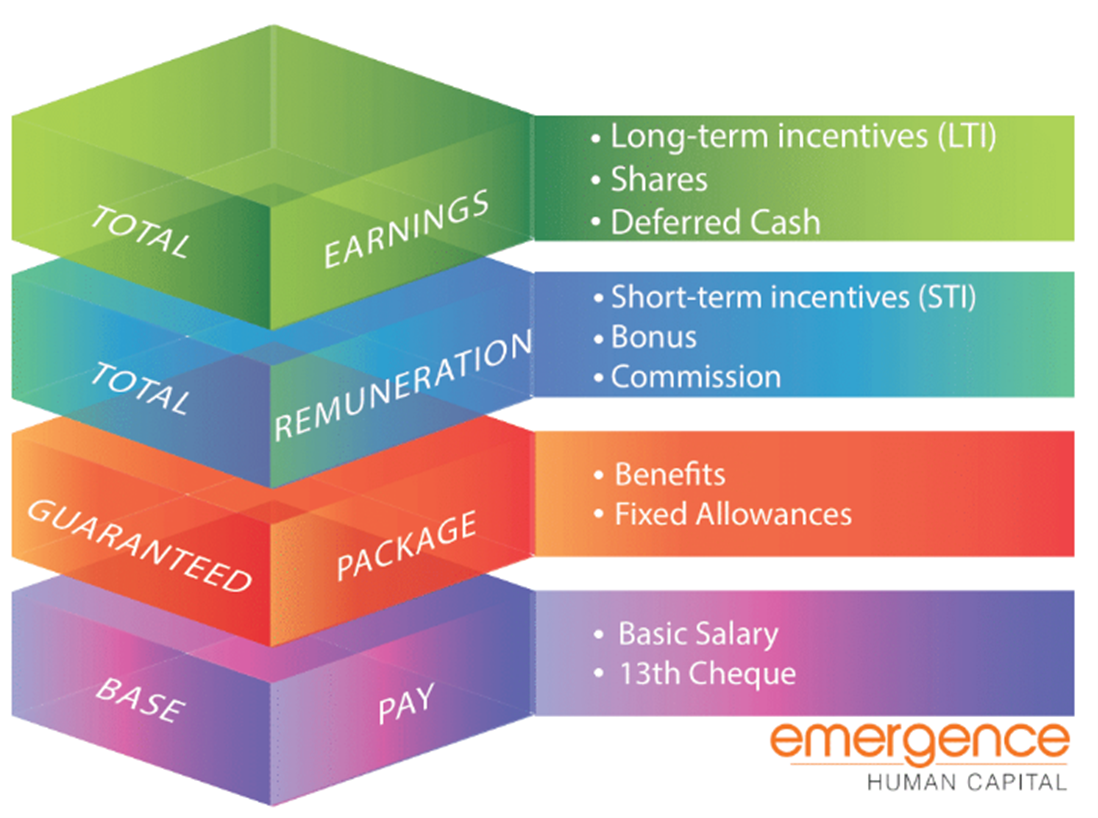
The components of the Total Rewards Model that Emergence provides data on includes:
- Basic salary.
- Cost to Company / Guaranteed Package; and
- Short- & Long-term incentives.
Emergence Human Capital Benchmarks all levels of staff, from General Staff to Executive.